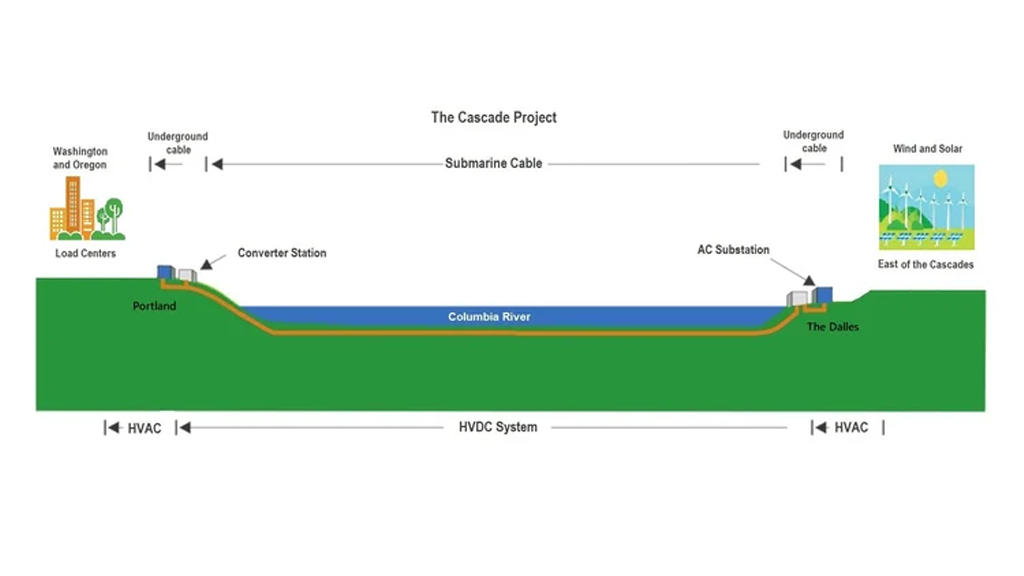
Details of the proposal for a 100-mile high tension power line that would be laid beneath the Columbia River, rather than travel over land, was aired last week by developers of the project in three public meetings.

The underwater power line would bring energy produced on the east side of Oregon and Washington nearer to population centers of Portland and Seattle.
It would also move that power past bottlenecks in Portland to a north-south high-voltage transmission route, and then on to data centers on the Portland’s west side.
In its argument to build the transmission line, the Cascade Renewable Transmission project said that Oregon and Washington have passed laws calling for clean energy goals for electric utilities and demand for electricity in the Northwest will increase dramatically over the next 10 years. What’s missing the developer says is adequate transmission to meet those needs.
Washington’s goal is for the state’s utilities to be 80 percent carbon neutral by 2030 and 100 percent by 2045. Oregon’s goal takes an extra step, but gets to the same goal in 2040; 80 percent carbon neutral by 2030, 90 percent by 2035 and 100 percent by 2040.
Minimal east side to west side transmission capacity and a difficulty in siting new overland transmission lines is resulting in a bottleneck from east side generating facilities, such as wind generation, Cascade Renewable said in its presentation to Washington’s Energy Facility Site Evaluation Council. (20251117_CRTPresentation.pdf).
That’s how Cascade Renewable is framing its project to lay transmission cable under the Columbia River. It says its project meets the renewable energy goals, provides transmission flexibility, helps to meet the region’s growing energy needs and will not interfere with other infrastructure.
The project is not without its distractors, according to a Nov. 15 article by Henry Brannan in The Columbian newspaper. Brannan wrote that “environmental and Native rights groups oppose the project because of the harm it stands to cause to the river’s struggling ecology and long-neglected treaty-reserved rights for Native nations around the Columbia River Basin,” and that the U.S. Army Corps of Engineers said the proposed project’s permitting application lacked information.
The project consists of about 100-miles of an underwater and underground high voltage direct current transmission line carrying 1,100 megawatts of energy generated east of the Cascades to customers west of the Cascades, the developer says. The capacity is enough to serve about 800,00 homes.
The line would consist of a 12-inch bundle of two 6-inch diameter HVDC cables plus a 1-inch fiber optic cable buried beneath the Columbia River from The Dalles to Portland. The line would bypass Bonneville Dam via a 7.5 mile underground route on existing public right of ways.
Direct current power lines are more efficient than the more traditional alternating current power lines, but require conversion to AC for use in homes and businesses. That would occur in The Dalles where the Bonneville Power Administration already has a DC power station, and at the Rivergate industrial facility in Portland.
Regarding the power line’s construction, Cascade Renewables says:
* A hydro-plow fluidizes a 24-inch-wide trench while the cable bundle is simultaneously installed 10-15 feet below the Corps-authorized river bottom. The sediment, primarily sand, then settles, covering the cable and refilling the trench.
* A single vessel and tug, of typical size on the Columbia River, will be used to install the cable bundle. The vessel moves very slowly, with approximate speeds of 1 – 1.5 miles per day.
* The in-water portion of the project can be completed in 8-9 months, split over the duration of two permitted winter work windows.
“The lead developer, PowerBridge, LLC has successfully developed, financed, built, and currently owns and operates two similar underwater HVDC transmission systems in New York and New Jersey,” Cascade Renewable says.
To air differences, the EFSEC Council held three public information meetings November 17, 18 and 19, to discuss Cascade Renewable’s proposal.