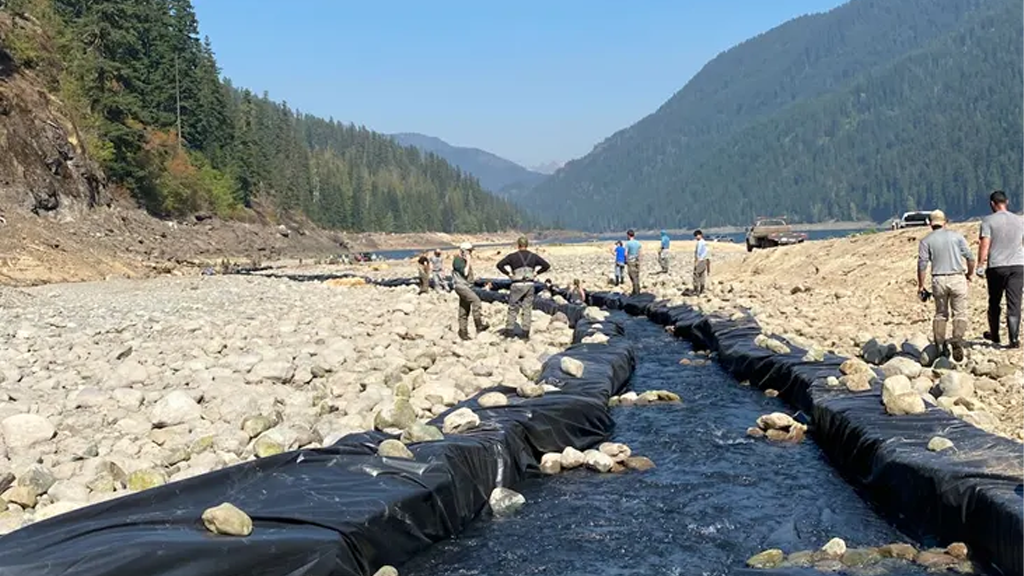
Above photo: WDFW staff and partners post-construction. Photo by WDFW.
July through September are the dryest and hottest parts of the year, with 2025 being the third consecutive year of drought in the Yakima River Basin.

Many summers in the Yakima River Basin, particularly in drought years, Box Canyon Creek, which flows into Kachess Reservoir in Kittitas County, dries up to the point that it no longer connects to the reservoir. This spells serious trouble for migrating bull trout traveling from the reservoir into the creek to spawn.
Bull trout are listed as threatened under the Endangered Species Act. Washington Department of Fish and Wildlife estimates that only about 75 to 100 adult bull trout are left in the Box Canyon Creek population, with their survival on a precipice.
While many outdoor enthusiasts appreciate Kachess Reservoir for its stunning beauty and refreshing waters, they may not realize its importance for bull trout spawning as well as irrigation throughout the Yakima River Basin. Reservoir operations reduce water levels, leaving fish stranded.
Reservoir conditions, combined with drought, can result in Box Canyon Creek completely disconnecting from Kachess Reservoir, like it did this fall. This combination has the potential to devastate the local population of bull trout that travel from the reservoir into the creek to spawn.
Fortunately, dedicated groups come to the rescue, providing physical labor and construction equipment to create a flume (or channel) for bull trout to swim through on their way home.
The emergency flume is made of straw bales, plastic lining, and rocks and functions as a kind of ’slip and slide’ for the fish. The flume, combined with rains, helps bull trout swim freely from the reservoir to their Box Canyon Creek home where they’re able to build redds, or ‘fish nests’ to reproduce.
WDFW staff, contracted by United States Bureau of Reclamation have been monitoring Box Canyon Creek and drought conditions in the area, since 2015. Staff biologists watch carefully each summer for potential fish passage problems during the summer and fall. The monitoring enables the Department to be prepared when the fish need extra support.
In 2025, WDFW again led a massive effort to reconnect this bull trout habitat — the creek and reservoir alongside partners including the USBR, Mid-Columbia Fisheries Enhancement Group, Kittitas Conservation Trust, Roza Irrigation District, Kittitas Reclamation District, U.S. Fish and Wildlife Service, Yakima Tieton Irrigation District, Yakima Basin Fish and Wildlife Recovery Board, U.S. Forest Service, and other volunteers.
The team built an approximately 700-foot-long flume in two sections across the reservoir bed. They secured a plastic lining over straw bale walls and drove T-posts through to hold the walls in place. They placed rocks and other structures strategically inside the flume to create different water flows that provide places for fish to hide and rest.
Staff and partners monitored the flume daily for fish, predators, poaching, and vandalism. They adjusted the flume and rock features, maintaining fish passage as weather changed and natural shifts occurred.
“The shared commitment and enthusiasm of the team made this year’s project another success,” said Josh Rogala, WDFW fish passage biologist. “Months of coordination calls, meetings, and preparation culminated in a rigorous, half-day construction of a temporary but effective fish passageway. We’re inspired by the way our partners continually come together to help support a better future for bull trout recovery here in the reservoir.”
WDFW removed the flume in late October after the fall rains returned and the bull trout had completed their migration to spawn.
This year, project participants detected seven bull trout redds and nine adult bull trout in Box Canyon Creek — a great sign that the fish are successfully using the flume and starting to reproduce. Other fish were also detected recently accessing the creek habitat.
Last year, after WDFW and partners installed the flume, project participants detected two bull trout upstream in Box Canyon Creek and three bull trout in the flume. Biologists counted a total of 10 redds (a nest where fish lay their eggs) in Box Canyon Creek in 2023. In 2024, that number was eight.
Some of the redds would not exist without the artificial creek. While those numbers may seem extremely low, they reflect just how low bull trout populations are in this area.
This year’s project builds on nearly a decade of similar efforts. WDFW built a temporary fish passage flume at Box Canyon Creek seven times before, in 2001, 2003, 2005, 2015, 2019, 2023, 2024, and 2025. Construction in the early years was extremely arduous, taking several long days. Thanks to many cooperators pitching in, recent years’ efforts are much more efficient.