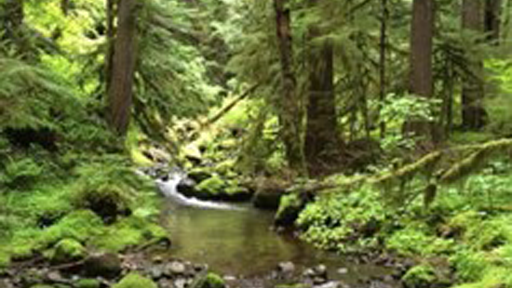
A forest practices rule targeting small, non-fish bearing perennial streams in western Washington was approved by the state’s Forest Practices Board Nov. 12. The rule includes wider logging buffers and provides options to reduce warming in the streams that are generally found in higher elevations where the streams originate, but which feed larger streams that host trout, salmon and steelhead.

The widths of the new buffers vary, but the rule generally requires setbacks from the current 50 foot rule to 75 feet, seeking an “expanded continuous buffer of trees around these streams,” the state’s Department of Ecology wrote, announcing the water quality proposal and the Board’s decision meeting.
The proposal will come with significant costs to landowners and logging companies that could be as high as $23 million in lost timber sales as well as a loss of land values, the Board’s analysis says.
Washington’s original Forests and Fish law, adopted in 1999, established a collaborative framework bringing together landowners, tribes and local governments to balance environmental protection with sustainable forestry practices, according to 19th District State Representatives Jim Walsh and Joel McEntire, who represent timber-reliant counties in Southwest Washington that will be heavily affected by the new restrictions. For more than two decades, they said, that partnership has guided “responsible forest management across the state.”
Of the Forest Practices Board’s decision, they said:
“Today’s proposal adopted by the Washington Forest Practices Board is a disaster — an affront to science, proven forest practices, and the financial well-being of all Washingtonians.
“This reckless decision will devastate small forest landowners and the rural communities they sustain. By removing millions in local tax revenue tied to timber harvests, the board has effectively cut funding from classrooms, teachers, and essential local services. Washington deserves better than this. The Forest Practices Board should have gone back to the table and done the hard work of collaboration — balancing environmental stewardship with economic survival. Instead, they chose politics over people.”
Ecology’s role in the proposed rule is to ensure that it would meet state water pollution control laws. The agency’s analysis of the proposed rule tested whether the new rule would cause warming of water that was already of high quality and, if warming does occur, would it be necessary or in the public interest to allow it.
“Our analysis found that the Forest Practices Board’s proposed rule would substantially improve water quality for non-fish bearing perennial streams in Western Washington,” Ecology wrote in its proposal for the new rule. “The proposed buffer options should result in minimal stream warming, and any warming that may occur is likely to be shorter than what happens under current rules. We determined it is necessary and in the overriding public interest to allow the rule to be adopted, should the Board decide to do so. And finally, we note that further Adaptive Management Program research is necessary, some of which is already underway.”
According to the Board, the regulations include requirements for riparian buffers, where timber harvest would be restricted. The sizes of the buffers will vary depending on whether a stream is known fish habitat or a non-fish bearing type.
“Riparian buffers on Type N (non-fish bearing) waters are designed to protect water quality, stabilize stream banks, provide habitat for riparian and aquatic species, and maintain stream temperatures,” the proposal said. “Buffering requirements differ between Type N streams that are perennial (Type Np) and that flow only seasonally (Type Ns). Type Np streams are typically found in the upper watersheds and headwaters in western Washington because they begin at the uppermost point of perennial flow.”
In its comments on the proposed rule, the Forests and Fish Conservation Caucus said, “The Adaptive Management Program has demonstrated, and all participants have agreed, that existing Type Np buffers fail to meet water quality standards. Reinforcing that point, decades of research show that current 50-foot buffers do not protect water quality. Ecology has both the responsibility and authority to determine whether forest practice regulations meet water quality standards….”
The new rule, however, does come at a cost. It will impact small timber harvesting businesses and forest landowners in the state and result in “more than minor costs to businesses, stemming from limitations on timber harvest in riparian forest,” an analysis by the Forest Practices Board says. “The analysis also identifies that the rule is likely to result in lost jobs due to restrictions in timber harvest across industries reliant on timber harvest for employment.”
Generally, the existing rule that the new rule replaces requires a 50-foot, no-harvest buffer and the proposed rule, in most cases, increases buffer width and length. For details see the Western Washington Type Np water buffer rule here: bc_fpb_cr102_np_20250606.pdf.
Much of the economic impact is due to harvest restrictions. The Board analysis found that a protected non-fish bearing mile is likely to require an additional 3.6 to 3.9 acres of no-harvest restrictions and an up to 3.7 to 4 acres with partial harvest restrictions. The analysis estimates that some 19,000 to 44,000 miles of non-fish bearing streams could be impacted, with a loss of land value per mile of $17,000 to $23,000.
At the low end, there could be 67,000 acres of no-cut buffers and 2,900 acres of partial-cut buffers. At the high end, there could be 170,000 acres of no-cut buffers and 8,600 acres of partial-cut buffers, the analysis says.
The new rule could also result in lost timber sales for landowners in western Washington ranging from $5.1 million to $23 million, based on 2021 stumpage sales and harvest levels.
“Therefore, under this approach, it is highly likely that small businesses will experience more than minor costs stemming from the proposed rule,” the Board analysis says.
Comments to Ecology about their analysis is here: : Draft Tier II Analysis of Forest Practices Board’s draft rule