NOAA Fisheries Releases Three ‘Flagship’ Reports On Fisheries Stock Status, Economics
NOAA Fisheries has released three of what the agency calls “flagship” reports: Status of Stocks 2025 Annual Report to Congress on the Status of U.S. Fisheries, 2024 Fisheries of the United States, and 2024 Fisheries Economics of the United States.
“Each of these reports is a crucial part of how we track and monitor the state of United States marine fisheries,” the agency said in a press release.
2025 Status of Stocks https://www.fisheries.noaa.gov/national/sustainable-fisheries/status-stocks-2025
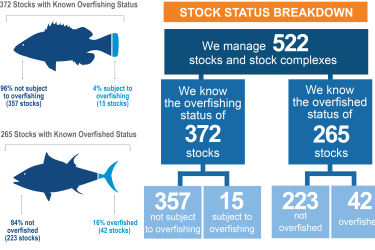
The is an annual report to Congress on the status of U.S. fisheries. We track 522 stocks or stock complexes to determine their status:
- Overfished: population size is too small
- Subject to overfishing: harvest rate is too high
- Rebuilt: target level supports maximum sustainable yield
In fiscal year 2025, NOAA Fisheries conducted 173 stock assessments and had two first-time stock status determinations as the result of improved or new scientific endeavors.
The 2025 Status of Stocks report shows “positive trends,” says NOAA.
“The number of stocks on the overfishing list decreased to an all-time low and another stock was added to the rebuilt list. That brings the number of rebuilt stocks to 52 since 2000. The number of stocks on the overfishing list dropped from 23 to 15 stocks. Of the 372 stocks with a known overfishing status, 96 percent are not subject to overfishing. The number of stocks on the overfished list remained the same at 42 stocks. Of the 265 stocks with a known overfished status, 84 percent are not overfished.”
Notably, Atlantic blue marlin was removed from the overfishing list for the first time since 1998 and Quillback rockfish (California) was added to the rebuilt list in 2025.
“Managing fisheries sustainably is an adaptive process that relies on sound science, innovative management approaches, effective enforcement, meaningful partnerships, and robust public participation. Partnerships with the regional fishery management councils, state and international partners, and interstate fisheries commissions are also key to the success of ending overfishing and rebuilding stocks,” said the press release.
2024 Fisheries of the United States https://www.fisheries.noaa.gov/resource/document/fisheries-united-states-reports and 2024 Fisheries Economics of the United States https://www.fisheries.noaa.gov/resource/document/fisheries-economics-united-states-reports
The 2024 editions of Fisheries of the United States and Fisheries Economics of the United States provide detailed information on commercial landings, recreational catch, trade, and economic impacts.
Key take-aways, says the agency, include:
- U.S. commercial fishing, seafood, and recreational fishing industries continue to have a broad, positive impact on the economy, collectively generating $321 billion in sales and supporting 1.7 million jobs in 2024
- U.S. commercial fisheries continued to play an essential role in our coastal economies, with total landings of 7.7 billion pounds generating $4.9 billion in revenue
- U.S. commercial fisheries supported 1 million jobs, generating $175 billion in sales, $44 billion in income, and $70 billion in value-added impacts nationwide
- Recreational fishing remains an important part of the U.S. tourism sector and coastal economies, supporting 685,000 jobs, generating $146 billion in sales impacts, and contributing $78.9 billion in value-added impacts nationwide.
“The data in these reports serve as a reference for informed decision-making in support of the Administration’s goal of restoring American seafood competitiveness. They demonstrate the need for NOAA’s efforts to promote domestic seafood production and address unfair trade practices.”
Seafood and the Economy
Seafood is part of a healthy diet, and the United States continues to rank high among seafood-consuming countries with consumption at 18.4 pounds per person, says NOAA.
“We live in a global marketplace with a robust and interconnected supply chain. The United States imported $25 billion worth of edible seafood products and exported $4.4 billion in 2024. Aquaculture is poised as a key driver to increase American seafood competitiveness; seafood farmers produced 561 million pounds of farmed seafood valued at $1.3 billion in 2024.”
“NOAA Fisheries plays a critical role in maintaining sustainable fisheries, which contribute significantly to the U.S. economy, provide important recreational opportunities, and strengthen American food security. The reports serve as foundational resources for understanding the state of the industry, identifying trends, and informing business decisions,” said the press release.
The entirety of the datasets in Fisheries of the United States and Fisheries Economics of the United States can be accessed in our Fisheries One Stop Shop database. https://www.fisheries.noaa.gov/foss/f?p=215:200:16735595728578:Mail