
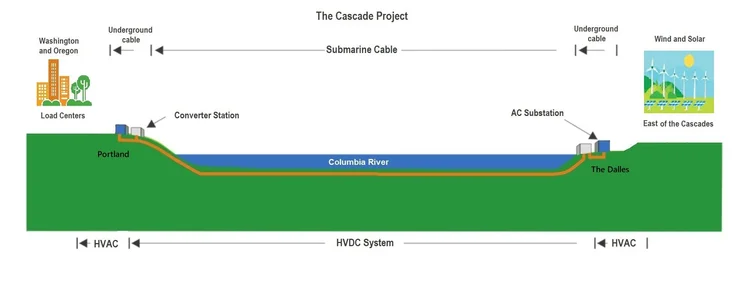
An environmental review of a nearly 80-mile high voltage transmission line that would be buried in the bed of the Columbia River from The Dalles to Portland was set in motion earlier this month with a public comment period that ends Feb. 4.
The U.S. Army Corps of Engineers issued a Notice of Intent Jan. 5 that it would prepare an Environmental Impact Statement for the Cascade Renewable Transmission Project, and it opened the process to public comment including two virtual scoping meetings at the end of this month.
In its Notice of Intent, the Corps said that the project is likely to adversely affect species listed under the federal Endangered Species Act, designated critical habitats and essential fish habitat. It may also have adverse effects on the aquatic ecosystem, fish and wildlife, navigation, recreation, water quality, and safety, the Corps said.
“As part of the National Environmental Policy Act (NEPA) process, we collect public comments to help shape the EIS,” said Joe Brock, the Corps’ Portland District project manager. “Public input is crucial to ensure we consider all potential impacts and alternatives. This process helps us better understand community concerns and make informed decisions.”
The EIS will assess the potential environmental, ecological, aesthetic, historical, cultural, and social impacts of the project, the Corps said.
The project proposes to bury a 12-inch in diameter high-voltage direct current cable for 78.9 miles in the bed of the Columbia River using hydroplow methods. The cable bundle will be installed 10 to 15 feet below the riverbed. Where the cable crosses the navigation channel below Bonneville Dam, it will be installed to a depth of at least 34 feet below dam.
Cascade Renewable Transmission, LLC had asked the Corps last year for Section 408 permission to build the project. As the lead agency under the federal National Environmental Policy Act, the Corps said it “has determined the proposed project may significantly affect the quality of the human environment and will prepare an environmental impact statement.”
Overall, the transmission line would extend 99.5-miles from The Dalles to Portland. According to the Corps’ website for the project (Cascade Renewable Transmission Environmental Impact Statement), it includes work in uplands, work in and under the Columbia River, work under the Oregon Slough and Columbia Slough and finishing the project with work under the Willamette River.
The 78.9 miles of work directly under the Columbia River is from River Mile 190 near The Dalles to RM 106 near Portland. The proposed transmission line would interconnect with the Bonneville Power Administration Big Eddy 500-kilovolt alternating current substation, located in The Dalles, and the Portland General Electric Harborton 230-kV AC substation in Portland and include a Bonneville Dam bypass. It would run through Wasco, Hood River and Multnomah counties in Oregon, and Klickitat, Skamania, and Clark counties in Washington.
Cascade Renewable Transmission, LLC would bury a 12-inch high voltage DC cable bundle in the river 10 to 15 feet below the mudline in the bed of the river, according to the Corps.
“Where the cable bundle crosses the navigation channel prism below Bonneville Dam, the cable bundle would be installed to an elevation of at least -34 feet Columbia River Datum/Mean Pool Elevation,” the website says. “Hydroplow installation would excavate and redeposit as much as 305,100 cubic yards (cy) of sediment in the Columbia River.”
Burying a cable under the Columbia River is not a simple task as other details of the project show. According to the Corps’ website for the project, those details include:
- Installing four temporary, three-sided sheet pile wet cofferdams measuring 70 feet wide by 300 feet long to isolate the land-to-water transition areas. Land-to-water horizontal directional drilling (HDD) in the Columbia River would occur at The Dalles near Stevenson, near North Bonneville and near Portland.
- Removal of up to 26,000 cubic yards of riverbed substrate using a clamshell dredge from inside the cofferdams (6,500 cy each). Upon completion of HDD activities, the dredged material would be discharged within the wet cofferdam and the wet cofferdam removed.
- Discharge up to 7,500 cy of rock or articulated concrete blocks in the Columbia River over 0.97 acres for cable protection in areas where the cable would be buried less than 5 feet deep in river substrate due to utility conflicts, or potential substrate limitations. The cable protection footprint would be up to 8 feet wide with a total length of 2.4 miles.
- Use HDD to install the cable bundle about 2,800 feet at elevation -95 feet NAVD88 (-90 feet CRD) under Oregon Slough (Columbia River south of Hayden Island in Portland).
- Utilize HDD for two 30-inch bores for approximately 2,000 feet at minimum elevation of -50 feet NAVD88 below the Columbia Slough and wetlands and approximately 2,450 feet at minimum elevation of -100 feet NAVD88 (-95 feet CRD) below the Willamette River to install two high voltage AC cables.
- Temporarily impact (excavation and backfill) 40-square feet of palustrine emergent wetland near Stevenson to facilitate open-trench installation of the cable bundle along Washington State Highway 14.
- Install HVDC cables within The Dalles Levee prism.
The EIS process begins with a 30-day scoping period that kicked-off Jan. 5. It ends Feb. 4. During this process, the Corps will collect comments from the public, tribes and agencies.
“This input informs the analysis of potential effects, the suite of alternatives that meet the project’s purpose and need, and the criteria for evaluation and comparison of alternatives,” the Corps said.
In addition to accepting comments by email or mail, the Corps will hold two virtual public scoping meetings.
January 28, 2026: 1:00pm – 3:00pm
Join by phone: 601-262-2433;
Phone conference ID: 586 938 06#
January 29, 2026: 6:00pm – 8:00pm
Join by phone: 601-262-2433
Phone conference ID: 128 989 315#
For more information or to submit written comments, visit the Corps’ website at https://www.nwp.usace.army.mil/CRT
NEPA requires the Corps, as the lead federal agency to prepare the EIS, to develop a schedule for the EIS and to complete the EIS in two years. NEPA also provides that the lead agency may extend the two-year deadline, in consultation with the applicant, to establish a new deadline that provides only so much additional time as is necessary to complete the EIS. The agency will establish any deadline extensions, as applicable, in consultation with the applicant, the Corps said.
The Corps’ Notice of Intent for the project is here: Public Notice Scoping informational slides are here: Cascade Renewable Transmission Project Environmental Impact Statement Preliminary design drawings are here: Cascade renewable transmission project: Environmental impact statement – Vancouver, Washington, Cascade renewable transmission – Project Management Reports – USACE Digital Library Corps’ Environmental Impact Determination is here: Memorandum For Record For Background, see:
— CBB, November 22, 2025, Company Proposes Underwater Power Line In Columbia River From The Dalles To Portland, Would Bring Eastside Power Closer To Population Centers, Company Proposes Underwater Power Line In Columbia River From The Dalles To Portland, Would Bring Eastside Power Closer To Population Centers – Columbia Basin Bulletin