
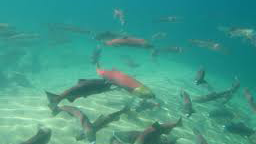
The Washington Department of Fish and Wildlife, the Upper Skagit Indian Tribe, the Swinomish Indian Tribal Community, and Puget Sound Energy announced that this year a record number of sockeye salmon returned to northwest Washington’s Skagit Bay and the Skagit River on their annual spawning migration.
From June through October 2025 more than 91,880 sockeye returned to the Skagit River system on their journey to the Baker River and Baker Lake.
Sockeye populations in the Baker River system had declined to just 99 returning fish in the mid-1980s, bringing the species to near extinction in these waters near Mount Baker.
“The rebound of the Baker sockeye population — and 2025’s record return of salmon — is a testament to successful co-management between the state and treaty tribes as well as close collaboration with Puget Sound Energy,” said Edward Eleazer, Regional Fish Program Manager for WDFW. “Together we’ve led operation of the Baker Hatchery and collaborated on fish passage and habitat restoration projects, resulting in successful seasons of fruitful fishing opportunities for the state and tribes, and a bright future ahead.”
“As the historical tribe of the Baker River Valley we are extremely pleased that PSE responded to our ask in 2003 to recover this run up to an annual average return of 75k-100k to enhance our culture, allowing our members to fish in the same locations as their ancestors did since time immemorial,” said Scott Schuyler, Natural Resources & Cultural Policy Representative for Upper Skagit Indian Tribe.
“These returns have significant meaning, spiritually and culturally, for our native people because those record returns allow us to not worry about where we’re going to get our fish this year — and that is priceless,” said Tandy Wilbur, Swinomish Natural Resources History Manager. “Having traditional fish available to us is something we’re taught by our ancestors and what we believe in wholeheartedly. It’s what the Swinomish people are all about.”
The success builds on PSE’s 2024 final expansion and completion of the Baker River Fish Hatchery, which now includes eight raceways, and four “naturalized” spawning beaches that provide enhanced conditions for artificial propagation and fish development before their release as juveniles to the Baker Project reservoirs.
“Our biologists and fisheries technicians have worked for decades with the local tribes along with government agencies to boost salmon and trout populations, particularly in rivers where we have hydropower operations,” said Ron Roberts, Puget Sound Energy’s Senior Vice Present of Energy Resources. “This partnership shows the great success and is a testament to the collaborative efforts of the various stakeholders.”
A key component of the restoration effort was PSE’s 2010 installation of an enhanced fish trap below Lower Baker Dam, which captures migrating adult sockeye and coho salmon for upstream transport around both Baker River dams — essentially providing a “fish taxi” service that allows these regionally significant salmon stocks to reach their historic spawning grounds.
Importantly, while a proportion of the juvenile fish originate from the hatchery, natural production is also a key contributor, as a proportion of the fish released to Baker Lake are conserved for natural spawning in the Baker River system. These adults spawn in the feeder streams including the Upper Baker River, contributing to the overall juvenile out-migration numbers and helping maintain natural behaviors while supporting population sustainability.
The adult releases of sockeye have also provided a relatively new and expanding recreational fishing opportunity for salmon in Baker Lake.
Earlier this year, PSE’s fish propagation and passage facilities achieved another milestone when over 1.5 million juvenile fish passed through the Baker Lake and Lake Shannon Floating Surface Collectors during their May outbound migration — also a new record.
The young salmon will journey down the Skagit River to the Pacific Ocean, with some traveling as far as the Gulf of Alaska. After spending two to three years maturing in marine waters, they return to their natal Baker River waters to complete the spawning cycle.