
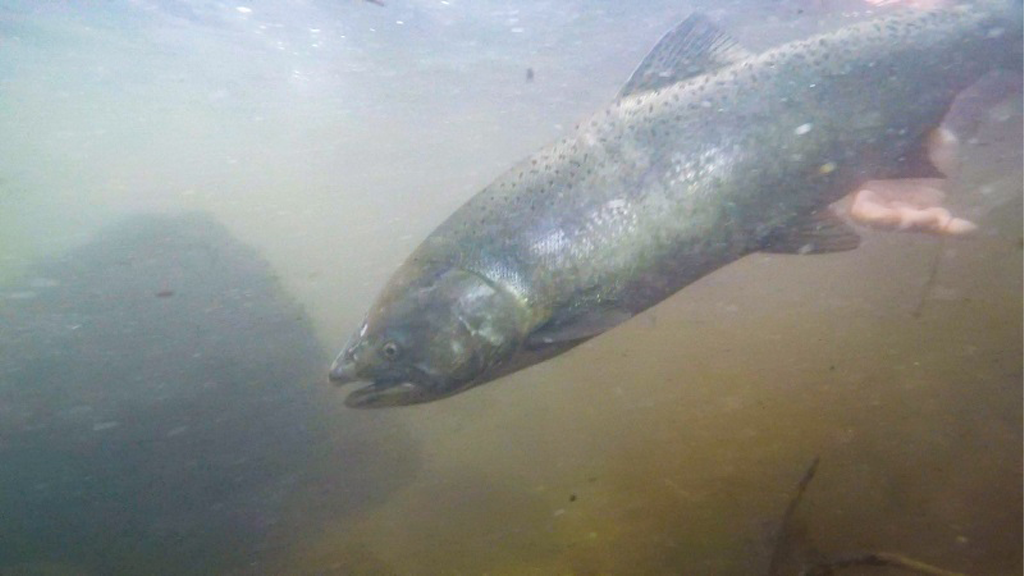
A 2022 petition to list Oregon Coast and Northern California Coastal Chinook salmon as threatened or endangered under the federal Endangered Species Act was denied by NOAA Fisheries this week.
In its status review, NOAA’s Northwest Fisheries Science Center in Seattle determined that the two evolutionary significant units are not currently in danger of extinction, nor are they likely to become so within the foreseeable future.
The original August 22, 2022 petition to list the ESUs was initiated by the Native Fish Society, Center for Biological Diversity and Umpqua Watersheds. They had asked that the ESUs be considered by NOAA for listing, along with a designation of critical habitat at the same time.
In its December 9, 2025 Federal Register notice, NOAA said: “Based on the best scientific and commercial information available, including the status review report, and taking into account efforts being made to protect the species, we have determined that the OC and SONCC Chinook salmon ESUs do not warrant listing.”
“This decision ignores the agency’s own science and wastes an invaluable opportunity to avail the federal resources and leadership needed to set Oregon’s coastal Chinook salmon on a pathway to recovery,” said Mark Sherwood, Native Fish Society’s Executive Director. “We will continue to pursue recovery for these iconic native fish and the coastal communities, cultures, and ecosystems they hold together.”
In 2022, the petitioners gave as an alternative to separate out the spring run of OC and SONCC Chinook ESUs from the fall run of the fish, but on Jan. 11, 2023, NOAA said that option was not warranted.
At the same time, the federal fisheries agency said that the “petition presents substantial scientific information indicating the petitioned action to list the OC and SONCC Chinook salmon ESUs may be warranted …” and proceeded with a status review to “to determine whether the petitioned action to list the OC and SONCC ESUs is warranted.”
In the recent extinction risk assessment for OC and SONCC Chinook published in the Dec. 9 Federal Register, NOAA concluded that both ESUs are at low risk of extinction due to similar factors.
“They both have high overall abundance, with numerous, well-distributed spawning populations,” the notice says. “Additionally, their high productivity allows them to maintain abundance even in the face of relatively high exploitation rates. In evaluation of the threat factors identified in section 4(a)(1) of the ESA, we concluded that the factors do not contribute substantially to rangewide extinction risk now or in the foreseeable future.”
The Science Center status review of the two ESUs was actually completed more than a year ago in January 2024 (Biological Status of Oregon Coast and Southern Oregon/Northern California Coastal Chinook Salmon : Report of the Status Review Team).
Chinook salmon are anadromous fish, returning from the ocean to the freshwater streams where they were born to reproduce. The Oregon and California Chinook salmon populations contain both early and late-run variants, otherwise known as spring-run and fall-run Chinook salmon.
Spring-run Chinook salmon enter coastal rivers from the ocean in the spring and migrate upstream as they mature, holding in deep pools in rivers through the summer, and spawning in early fall in the upper reaches of watersheds. Conversely, fall-run Chinook enter the rivers in the fall and spawn shortly thereafter.
Spring-run Chinook in Oregon and Northern California suffer from chronically low abundance. These fish have specific habitat needs, and there are numerous unaddressed threats to every population and their habitat in Oregon and Northern California.
The current OC and SONCC Chinook salmon ESUs were identified by NOAA in the late 1990s, and include fall- and spring-run Chinook salmon spawning in rivers on the Oregon and northern California coasts, the status review says.
Identifying the freshwater range of OC Chinook, the status review says it includes rivers on the Oregon coast south of the mouth of the Columbia River down to and including the Elk River, located near Port Orford. The range of the SONCC Chinook extends from Brush Creek (just south of the Elk River) in the north to the lower portion of the Klamath River at its confluence with the Trinity River in California.
NOAA summed up the status of all OC Chinook populations, saying that the natural-origin abundance of the fall-run fish was between 100,000 and 200,000 spawners, and the spring-run natural-origin populations combined were between 2,500 and 5,000 spawners. The populations ranged from 100,000 to 500,000 in the 19th century.
“Trends were variable among populations, with some populations experiencing unusually low recent abundances,” the status review says. “Among fall-run populations, about half of the populations have increased over the past 15 years and about half have declined. The two spring-run populations have declined over the past 15 years, but total spring-run abundance remains higher than it was prior to 1960. The spring component of the predominantly fall-run populations is not well monitored, but the available data did not indicate any obvious downward or upward trends.”
For SONCC Chinook, NOAA found spawning abundance data for one spring-run and six fall-run populations, but together they made up the major SONCC Chinook spawning populations.
“Data for the Smith River, an apparently sizable population, were insufficient to evaluate trends. Summed across the ESU (excluding the Smith River), total abundance of fall-run Chinook salmon during the period 1990–2022 typically ranged from 30,000 to more than 125,000 natural-origin spawners. Several estimates for the Smith River from 2010 to 2021 were between 10,000 and 20,000 fall-run Chinook salmon,” the status review says.
The only major spring-run Chinook population was in the upper Rogue River. Between 1990 and 2022 the population ranged from a few thousand to more than 10,000 natural-origin spawners, along with similar numbers of hatchery-origin spawners. NOAA estimated the population of the spring-run fish between 1940 to the late 1980s to be 30,000 to 50,000 fish.
“Trends over the past 15 years for the fall-run populations were generally negative, and variable but without an obvious trend for the Rogue River spring-run population,” the status review says.
Estimates of late-19th century run sizes for the SONCC Chinook salmon ESU ranged from about 100,000 to 300,000 Chinook salmon
“We followed the rangewide assessment with a significant portion of its range extinction risk assessment and we did not find any portions of the OC or SONCC ESU’s range that were both significant and at risk of extinction,” NOAA concluded.
The Dec. 9 Federal Register notice where NOAA published its findings and determination: (Federal Register :: Endangered and Threatened Wildlife and Plants; Notice of 12-Month Finding on a Petition To List the Oregon Coast and Southern Oregon and Northern California Coastal Chinook Salmon Evolutionarily Significant Units Under the Endangered Species Act).
The Jan. 11, 2023 Federal Register notice announcing the status review is here Federal Register :: Endangered and Threatened Wildlife; 90-Day Finding on a Petition To List Oregon Coast and Southern Oregon and Northern California Coastal Chinook Salmon as Threatened or Endangered Under the Endangered Species Act
For information on the conservation groups’ petition and federal actions, see: https://www.fisheries.noaa.gov/action/2022-petition-list-oregon-coast-chinook-salmon-and-southern-oregon-and-northern-california
For background, see:
— CBB, April 5, 2024, NOAA Releases Status Review For Oregon Coast/Northern California Chinook, Low To Moderate Risk Of Extinction; Listing Decision Coming, NOAA Releases Status Review For Oregon Coast/Northern California Chinook, Low To Moderate Risk Of Extinction; Listing Decision Coming – Columbia Basin Bulletin
— CBB, October 26, 2023, CONSERVATION GROUPS SAY VERY LOW RETURN OF WILD SPRING CHINOOK TO SOUTHERN OREGON COASTAL RIVER SHOWS NEED FOR ESA LISTING, https://cbbulletin.com/conservation-groups-say-very-low-return-of-wild-spring-chinook-to-southern-oregon-coastal-river-shows-need-for-esa-listing/
— CBB, January 13, 2023, NOAA TO CONSIDER ESA-LISTING FOR OREGON COAST, NORTHERN CALIFORNIA SPRING/FALL CHINOOK SALMON, https://cbbulletin.com/noaa-to-consider-esa-listing-for-oregon-coast-northern-california-spring-fall-chinook-salmon/
— CBB, April 16, 2020, NOAA FISHERIES ANNOUNCES STATUS REVIEW OF OREGON COAST SPRING-RUN CHINOOK TO DETERMINE IF PETITIONED ESA PROTECTIONS WARRANTED; CURRENTLY MANAGED WITH FALL-RUN, https://cbbulletin.com/noaa-fisheries-announces-status-review-of-oregon-coast-spring-run-chinook-to-determine-if-petitioned-esa-protections-warranted-currently-managed-with-fall-run/
— CBB, September 26, 2019, GROUPS PETITION TO ESA-LIST OREGON COAST SPRING CHINOOK, SAY DISTINCT FROM FALL-RUN CHINOOK, https://cbbulletin.com/groups-petition-to-esa-list-oregon-coast-spring-chinook-say-distinct-from-fall-run-chinook/
— CBB, December 16, 2016, “Recovery Plan Aims To Make Oregon Coast Coho First West Coast Salmonid To Be Eligible For Delisting,” https://www.www.www.cbbulletin.com/recovery-plan-aims-to-make-oregon-coast-coho-first-west-coast-salmonid-to-be-eligible-for-delisting/