
How and where water bird predation impacts juvenile salmon and steelhead must be considered on a case- by-case basis before taking action against the birds, according to a new report being considered at this week’s Washington Fish and Wildlife Commission meeting.
When determining whether predation on both hatchery and Endangered Species Act-listed fish in Washington’s rivers — including Columbia River basin mainstem and tributaries — by American white pelicans, Caspian terns, double-crested cormorants and, to a lesser extent, California and ring-billed gulls, it is impossible to make general statements like “Bird species [X] impacts threatened or endangered salmonid species [X],” the Avian Salmon Predation Working Group said in its report to the Washington legislature.
Instead, the Working Group says it endorses the Pacific Flyway Council’s guidance on determining migratory bird predation impacts on fish resources, which states, “Responses to perceived avian predation issues [should be] based on sound science.”
In its report, the Working Group wrote that “a clear predation threshold should be developed using watershed- and salmon stock-specific predation rates and adult returns; an understanding of how predation impacts treaty rights and obligations; and an understanding of economic implications of the management actions, such as the cost-effectiveness of monitoring.”
There are 14 Evolutionarily Significant Units (salmon) or Distinct Population Segments (steelhead) in Washington that are listed under the ESA, according to the report.
“Satisfying the ESA is a critical, but narrow component of salmon recovery that is directed at avoiding extinction; more broadly, the objective is a more robust ‘healthy and harvestable’ target that reflects the importance of salmon to Pacific Northwest cultures, economies, and ecosystems,” the report says.
In his letter to the legislature introducing the report, WDFW director Kelly Susewind said that the Avian Salmon Predation Working Group was formed by WDFW and tasked to complete the report to the legislature by Substitute House Bill 2293, passed last year.
“The ASPWG was tasked with identifying all avian species that contribute to the predation of juvenile salmon at a population level, determining whether such species are adversely impacting the recovery of any threatened or endangered salmon species, and identifying remedies to predation,” Susewind wrote in his letter. “The report compiles useful data and existing knowledge about avian salmon predation in Washington and makes recommendations for how the legislature can support the Washington Department of Fish and Wildlife (WDFW) on this complex situation.”
The Fish and Wildlife Commission is hearing the report for the first time at its meeting this weekend, Nov. 13 through 15 in Lynnwood, WA.
In the report, the Working Group characterized predation as a “natural, dynamic, and complex ecosystem process” with both predator and prey as valuable components of naturally functioning ecosystems.
“Many species of birds in Washington eat fish, especially small and/or schooling fish, including juvenile salmonids,” the report says. “Abundance and distribution of birds and fish, as well as the predation process, have been altered by human activities and structures. In some cases, there have been attempts to characterize and control predation to benefit salmonids, resulting in varied outcomes and conclusions.”
Cormorants
The three nesting cormorant species in Washington are pelagic, Brandt’s and double-crested. All eat fish, but pelagic and Brandt’s are restricted to marine or estuarine environments, where they eat a variety of fish and are not necessarily focused on salmonids, according to the report. However, double crested cormorants use natural and manmade structures, such as channel markers, bridges and transmission towers, for nesting, sometimes closer to out-migrating juvenile salmon and steelhead. While they likely do not eat salmonids in Puget Sound, they do prey on salmon and steelhead in the Columbia River basin, the report says. Still, the western double-crested cormorant population has declined in recent years. More than 73,000 breeding pairs were counted in 2014, but that number declined to about 50,000 in 2022, the last year that the Working Group had information on their numbers.
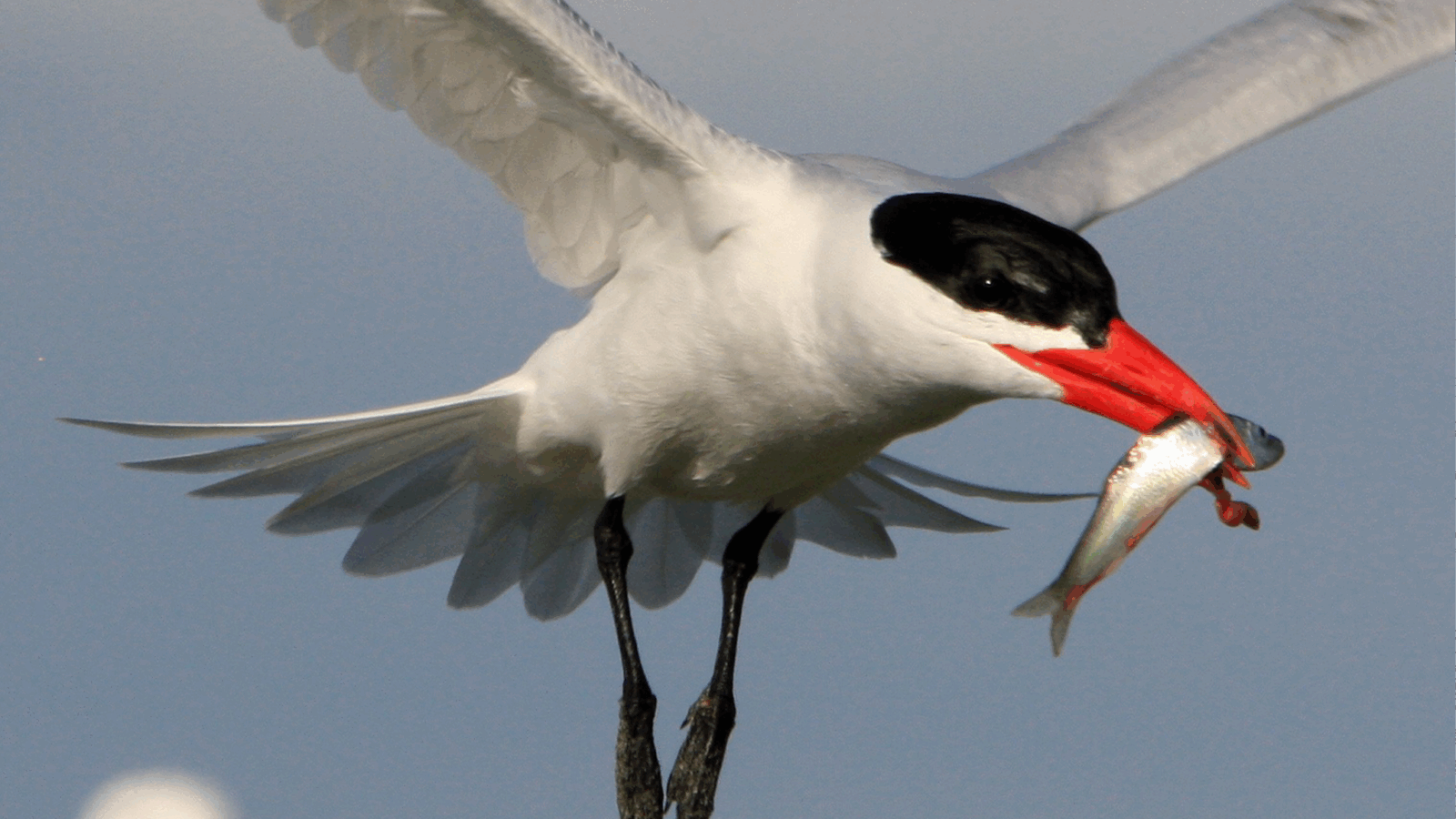
Caspian Terns
The Pacific Flyway population of Caspian terns has declined by at least half since 2010. Driven by NOAA Fisheries’ biological opinions covering federal Columbia River dams, three management plans were developed by the U.S. Army Corps of Engineers, the U.S. Fish and Wildlife Service and the U.S. Bureau of Reclamation to attempt to reduce the impacts of predation by both Caspian terns and double-crested cormorants on ESA-listed juvenile salmon and steelhead. These plans prescribed actions to reduce breeding colony size in critical areas of the river. Actions included planting vegetation, hazing, egg removal and lethally removing birds to reach target nesting populations. Two of the plans focused on Caspian terns and double-crested cormorants in the Columbia estuary, and one addressed terns nesting at inland islands.
Here’s the outcome of cormorant and tern management actions in the Columbia River estuary:
— Predation by Caspian terns on three islands specified in the plans has decreased with targeted management efforts.
— Double-crested cormorants were successfully reduced on East Sand Island in the Columbia River estuary, which caused the birds to shift to areas in the upper estuary, thus increasing predation at the Astoria-Megler bridge where more of the prey are salmon and steelhead. Adaptive management continues to be necessary to achieve reduced predation impacts by cormorants.
— Management of Caspian terns since 2008 has reduced the colony on East Sand Island to below the target colony size in the plan, and the colony has experienced complete nesting failure in six out of the last nine years (2016-2024). Additionally, the Pacific Flyway population has decreased by more than 50 percent since management began in 2008, triggering an adaptive management threshold for reducing the decline.
Pelicans
Brown pelicans are restricted to marine and estuarine habitats and eat a variety of fish, foraging by plunge-diving headfirst. Brown pelicans do not breed in Washington and are only present during the post-breeding season (May-November).
American white pelicans nest in colonies on islands in fresh water and mostly forage for a wide variety of fish, including salmon and steelhead, in groups, concentrating prey into shallow water. They are the largest water bird in the U.S. and can have a wingspan as large as 10 feet and can weigh up to 16 pounds. They have also been documented foraging at dam spillways solo or in groups, according to the study. Nesting colonies are on Badger Island and Miller Sands Spit in the Columbia River, although it appears the Badger Island colony was abandoned in 2025. Most white pelicans migrate out of Washington during winter. Both the Flyway population and the Washington breeding colonies have declined in recent years.
There are also reports that white pelicans at colonies in the mid-Columbia and lower Snake have been preying on adult sockeye salmon, according to Allen Evans, scientist with RealTime Research in Bend, OR, speaking to the Northwest Power and Conservation Council in August of 2024.
–See CBB, August 18, 2024, Despite 20 Years Of Management Actions, Avian Predation Remains Substantial Source Of Columbia River Salmon, Steelhead Mortality, Despite 20 Years Of Management Actions, Avian Predation Remains Substantial Source Of Columbia River Salmon, Steelhead Mortality – Columbia Basin Bulletin
Gulls
Of the ten species of gulls found in Washington, California and ring-billed gulls are mostly freshwater dependent, nesting in colonies, sometimes alongside Caspian terns. They have diverse diets, limited by their inability to dive or swim underwater, so they steal food from other fish-eating species. Their complex behaviors make accurate estimates of their direct predation difficult, the report says.
According to the Working Group report, most of the information about avian predation on salmon and steelhead and about predation management is from Columbia River studies. Lessons learned include:
— Consumption of salmonid smolts by piscivorous birds is highly variable across bird species, fish population, and site; not all species/colonies threaten smolt survival in the CRS.
— Impacts to salmonids vary based on the specific phenology of breeding activities and the associated energetic demands (timing of colony arrival, incubation, and chick-rearing), as well as colony size, location, and species composition.
— Bird colonies in the Columbia River estuary, where there are a variety of available fish prey species, generally consume less salmon as a percentage of their total diet than bird colonies upriver.
Despite the amount of information available, there continues to be knowledge gaps. In general, those gaps include:
Limited avian diet information. “It is difficult to quantify diet and foraging dynamics for species that are flexible and adaptive in their prey requirements and have highly migratory behavior and large geographic ranges that span international, state, tribal, and local jurisdictions,” the report says.
Asymmetrical regional data and knowledge. Relatively little is known about avian predation in Washington outside the Columbia River. It has not been as well studied on the coast or in the Salish Sea and associated riverine systems.
Lack of clear management goals. “Avian predation management plans should be implemented with a clear goal regarding the anticipated benefit to salmonids in mind,” the report says. “Returning adult fish abundance, widely considered the ‘gold standard’ for monitoring salmon, cannot be attributed to any particular condition or action because of the many factors that influence survival during the salmon life cycle. Therefore, establishing goals and metrics that are meaningful and achievable is a challenge.”
The Working Group developed two products to respond to the Legislature’s request that they “identify remedies:”
— Intervention Principles that guide the development of robust, long-term adaptive management plans for reducing avian predation, increasing juvenile salmonid survival, and building resiliency into salmon populations.
— An inventory of actions to dissuade avian predation that have been implemented or are being implemented in the region.
In addition, the Working Group recommended to the Washington legislature that it:
1. Fund research to examine geographically specific anecdotes of salmon predation by birds, particularly Puget Sound rivers with at-risk salmon stocks and that are cited as places where avian salmon predation negatively impacts juvenile salmonid survival, including but not limited to the Stillaguamish River and the Nisqually River Delta, the report says.
2. Invest in WDFW’s capacity to coordinate with federal and state governments, tribes, and other regional entities to address avian predation issues in the Columbia River System.
3. Invest in Department-led work focused on closing data gaps and learning more about the shared needs of birds and salmon. This work can make critical connections between ecosystem recovery actions that benefit both species, increase the Department’s ability to partner in avian predation policy and science, and promote coordination with tribes and other partners, the report says. As examples, the report suggests updating the Washington seabird colony inventory and diet database, and researching piscivorous bird species diet and foraging dynamics in Washington state.
The Avian Salmon Predation Working Group 2025 Report to the Washington State Legislature is at Avian Salmon Predation Working Group Report to the Legislature
For background, see:
— CBB, August 18, 2024, Despite 20 Years Of Management Actions, Avian Predation Remains Substantial Source Of Columbia River Salmon, Steelhead Mortality, Despite 20 Years Of Management Actions, Avian Predation Remains Substantial Source Of Columbia River Salmon, Steelhead Mortality – Columbia Basin Bulletin
— CBB, November 16, 2023, Déjà Vu: Oregon Study Says Once Again Salmon-Eating Cormorants Need To Somehow Be Relocated From Astoria Bridge Back To Estuary Island, https://columbiabasinbulletin.org/deja-vu-oregon-study-says-once-again-salmon-eating-cormorants-need-to-somehow-be-relocated-from-astoria-bridge-back-to-estuary-island/
— CBB, June 16, 2023, More Letters, Meetings About What To Do With Salmon-Eating Cormorants On Astoria Bridge; Chase Them Back To East Sand Island? Culling? https://columbiabasinbulletin.org/MORE-LETTERS-MEETINGS-ABOUT-WHAT-TO-DO-WITH-SALMON-EATING-CORMORANTS-ON-ASTORIA-BRIDGE-CHASE-THEM-BACK-TO-EAST-SAND-ISLAND-CULLING/
— CBB, January 26, 2023, COUNCIL REACHES OUT TO STATE AGENCIES TO DISCUSS ‘ALARMING CONCLUSIONS’ OF STUDY DETAILING IMPACTS TO SALMON FROM CORMORANTS ON ASTORIA BRIDGE, HTTPS://CBBULLETIN.COM/COUNCIL-REACHES-OUT-TO-STATE-AGENCIES-TO-DISCUSS-ALARMING-CONCLUSIONS-OF-STUDY-DETAILING-IMPACTS-TO-SALMON-FROM-CORMORANTS-ON-ASTORIA-BRIDGE/
— CBB, November 16, 2022, WHERE TO PUT THE BIRDS? RESEARCH SAYS CORMORANTS CHASED OFF COLUMBIA RIVER ESTUARY ISLAND EAT FAR MORE SALMON, STEELHEAD UPSTREAM, https://columbiabasinbulletin.org/where-to-put-the-birds-research-says-cormorants-chased-off-columbia-river-estuary-island-eat-far-more-salmon-steelhead-upstream/
— CBB, March 10, 2022, WHACK-A-MOLE: AGENCY THAT CHASED SALMON-EATING CORMORANTS OFF ESTUARY ISLAND NOW HAZING RE-LOCATED BIRDS ON ASTORIA BRIDGE OVER COLUMBIA RIVER, HTTPS://CBBULLETIN.COM/WHACK-A-MOLE-AGENCY-THAT-CHASED-SALMON-EATING-CORMORANTS-OFF-ESTUARY-ISLAND-NOW-HAZING-RE-LOCATED-BIRDS-ON-ASTORIA-BRIDGE-OVER-COLUMBIA-RIVER/